How to Style Everyday Minimalist Jewellery
Last updated: 2026-09-14
To know exactly how to style everyday minimalist jewellery, you must focus on balance and restraint. Start with one focal piece, stick to a single metal colour, and limit your total accessories to three delicate items per outfit. This creates a clean, intentional look without overwhelming your frame.
Key Takeaways
- Limit your daily look to a maximum of three delicate pieces to maintain a true minimalist aesthetic.
- Mix textures, such as hammered gold with smooth gold, instead of mixing metal colours to add depth.
- Invest in solid gold, gold-filled, or sterling silver core pieces to prevent daily tarnishing and fading.
- Keep necklace lengths between 16 and 18 inches so they sit cleanly above high necklines or rest neatly on the collarbone.
- Store your jewellery separately in soft pouches to prevent delicate chains from tangling and scratching.
What is everyday minimalist jewellery?
Minimalist jewellery relies on clean lines, simple geometric shapes, and negative space. It strips away ornate details, heavy gemstones, and chunky metals. Instead of drawing attention to the piece itself, minimalist jewellery enhances the wearer. It acts as a subtle accent rather than a loud statement.
Everyday minimalist jewellery specifically refers to pieces durable and versatile enough for daily wear. These are the items you put on Monday morning and leave on through Friday night. They transition effortlessly from a corporate office setting to a casual weekend brunch. The focus remains strictly on the metal’s quality and the piece’s structural simplicity. When you strip away the excess, the quality of what remains becomes obvious. That is why minimalist styling demands high-quality base metals rather than cheap alloys.
This approach to accessorising saves time, reduces decision fatigue, and ensures you always look polished. You never have to wonder if your earrings clash with your necklace. When every piece in your collection shares the same minimal design language, everything goes together automatically.
Why knowing how to style everyday minimalist jewellery matters in 2026
The trend cycle has accelerated so aggressively that consumers are exhausted by micro-trends. Fast fashion jewellery breaks quickly, turns skin green, and looks outdated within months. In response, 2026 has seen a massive shift toward “quiet luxury” and intentional consumption. People want fewer, better things.
Knowing how to style everyday minimalist jewellery matters right now because it signals confidence. When you wear a single, high-quality gold band instead of a stack of seven cheap rings, you show that you do not need to try hard to look put together. It aligns perfectly with modern capsule wardrobes. If your closet consists of high-quality basics—like a crisp white button-down, tailored trousers, and a cashmere sweater—your jewellery needs to match that energy.
Financially, mastering this style saves you money. Research from the McKinsey Global Fashion Index [verify] shows consumers are shifting their spending from disposable accessories to fine jewellery investments. When you understand the minimalist framework, you stop wasting $20 on trendy pieces you wear twice. Instead, you confidently invest $200 in a solid gold chain you will wear every day for the next ten years. The cost per wear drops to pennies.
The core pieces you need to start
You cannot build a minimalist style without the right foundation. If your jewellery box is full of heavy statement necklaces and neon resin rings, you cannot force a minimalist look. You need to curate a core collection. These three items form the non-negotiable base of any everyday minimalist jewellery wardrobe.
1. The delicate huggie hoop
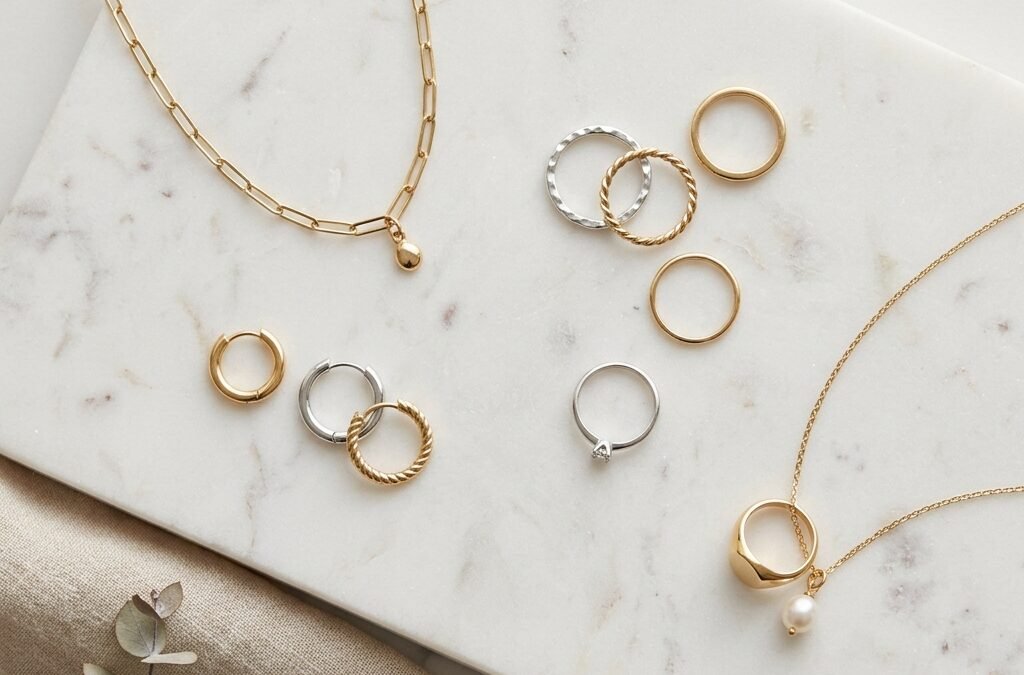
A huggie hoop sits tightly against the earlobe, leaving almost no space between the metal and your skin. It provides a tiny glint of light without the dramatic swing of a standard hoop. Choose a thickness between 1.5 millimetres and 2 millimetres. The diameter should perfectly hug your specific earlobe size, usually around 10 to 12 millimetres. These earrings are comfortable enough to sleep in and professional enough for any boardroom.
2. The fine chain necklace
Your core necklace must be a plain chain without a pendant. A simple cable chain, snake chain, or box chain works perfectly. Aim for a thickness of 1 millimetre. The ideal length is 16 inches for a collarbone fit, or 18 inches if you prefer it to rest slightly lower. A bare chain catches the light beautifully and never clashes with the neckline of your clothing.
3. The simple band ring
Forget cocktail rings and large stones. Your core ring should be a plain metal band. A 2-millimetre width offers enough durability for daily wear without looking bulky. You can choose a rounded dome profile for a classic look, or a flat-edge profile for a more modern, architectural feel. Wear it on your index or middle finger for the most impact.
Once you secure these three pieces in the same metal colour, you have a complete everyday look. You can wear all three together and perfectly adhere to the minimalist rule of three.
Types of minimalist jewellery
Once you secure your core pieces, you can slowly expand your collection. Understanding the types of minimalist jewellery helps you buy intentionally rather than impulsively. Every category serves a specific styling purpose.
Minimalist rings
Minimalist rings focus on the band rather than a centre stone. A plain dome band offers a traditional look. A flat cigar band provides a modern, structural edge. Chevron rings, which dip into a V-shape, look excellent worn alone or stacked. Signet rings with a blank face add slight volume while maintaining clean lines. Skip anything with pave diamonds or large prongs.
Minimalist necklaces
Beyond the simple chain, minimalist necklaces include tiny solitaire pendants, horizontal bar necklaces, and lariat drops. A solitaire pendant should feature a single bezel-set stone no larger than 3 millimetres. A horizontal bar necklace provides a sleek geometric line across the collarbone. Lariat necklaces feature a single chain that drops straight down, drawing the eye vertically. Keep the chains whisper-thin.
Minimalist bracelets
Bracelets present the biggest challenge for minimalists because they easily look cluttered. The solution is the simple bangle or the fine chain bracelet. A solid 2-millimetre gold bangle slides easily over the wrist and holds its shape. A fine cable chain bracelet rests softly against the skin. Avoid charm bracelets or thick cuffs. They disrupt the visual quietness of the minimalist aesthetic.
Minimalist earrings
If you want to move beyond the huggie hoop, look at threader earrings and bar studs. A bar stud is exactly what it sounds like: a tiny, straight line of metal sitting flush against the earlobe. Threader earrings consist of a fine chain that pulls directly through the piercing, leaving a delicate line of metal hanging on both sides. Both options offer striking geometry without heavy weight.
How to style everyday minimalist jewellery in 9 steps
Putting the pieces together requires discipline. Follow these nine steps every morning to guarantee a polished, intentional look. Do not skip the planning steps.
Step 1: Audit your outfit’s neckline
Your clothes dictate your jewellery. Before you open your jewellery box, look at your shirt. A high crewneck or turtleneck demands a necklace that sits clearly outside the fabric, usually 20 inches or longer, or no necklace at all. A V-neck perfectly frames an 18-inch pendant. A scoop neck pairs beautifully with a 16-inch chain. Never wear a necklace that hits exactly on the hemline of your shirt. It looks messy and the pendant will constantly flip underneath the fabric.
Step 2: Pick your primary focal point
Decide where you want the eye to land. You cannot highlight your ears, your neck, and your hands simultaneously without looking cluttered. Choose one zone. If you wear a crisp button-down shirt with an open collar, make your neck the focal point. If your hair is tied back in a sleek bun, highlight your ears. The minimalist rule is strict: draw attention to one specific area.
Step 3: Select your metal base and commit to it
Mixing metals works for bohemian or maximalist styles, but it destroys the minimalist aesthetic. Look at the hardware on your handbag and your belt buckle. If your bag has gold hardware, wear gold jewellery. Match your metal to your skin tone if you have no hardware. Warm undertones glow against yellow gold. Cool undertones pop against sterling silver or white gold. Pick one metal and wear it exclusively for the day.
Step 4: Apply the rule of three
Count the individual pieces of jewellery you intend to wear. Stop at three. A watch, a ring, and small earrings equal three. Two rings and a necklace equal three. If you put on a fourth piece, take one off immediately. The rule of three acts as a hard boundary against over-accessorising. It forces you to edit your choices down to the absolute essentials.
Step 5: Balance the visual weight across your body
Do not cluster your three pieces in one area. If you wear two rings on your right hand, do not put a bracelet on your right wrist. Move the visual weight to the left side. If you wear a slightly thicker chain necklace, keep your earrings incredibly small. Balance creates harmony. When all the heavy pieces sit in one spot, the styling looks accidental rather than intentional.
Step 6: Introduce subtle texture for depth
Since you cannot use bright colours or large gemstones, you must use texture to create visual interest. Pair a high-polish smooth ring with a subtly hammered or twisted ring. The different finishes reflect light differently. This technique makes your jewellery look expensive and carefully curated, even when the pieces are simple bands.
Step 7: Space out your rings
If you choose to wear two rings, never wear them on adjacent fingers unless they are specifically designed to stack on a single finger. Wearing a ring on your index finger and your middle finger causes the metals to clink together. It also looks crowded. Instead, wear one ring on your index finger and one on your ring finger. The negative space between the fingers reinforces the minimalist look.
Step 8: Match the scale to your frame
Minimalist does not always mean microscopic. The scale of your jewellery must match your physical frame. If you are tall with broad shoulders, a 0.5-millimetre chain will disappear completely. You need a 1.5-millimetre chain to achieve the same minimal effect. If you have very small hands, a 3-millimetre band might look like a chunky statement piece. Adjust the millimetre thickness based on your own proportions.
Step 9: Do the final mirror check
Stand two arm-lengths away from a full-length mirror. This is how the world sees you. If a piece of jewellery instantly grabs your attention from that distance, it is too loud for the minimalist aesthetic. The jewellery should blend seamlessly into your overall silhouette. If a piece stands out sharply, remove it.
Real-world example: The weekend coffee run
Theory is fine, but practical examples prove the concept. Here is exactly how a client styled her jewellery for a casual Saturday morning.
She wore a grey oversized cashmere sweater with a tight crew neckline. Because the neckline was high and thick, she skipped the necklace entirely (Step 1). She pulled her hair back into a low clip, making her ears the focal point (Step 2). She chose solid 14k yellow gold to warm up the grey sweater (Step 3). She put on 15-millimetre thin gold hoops, a plain gold signet ring on her left pinky, and a twisted gold band on her right index finger. That equals exactly three pieces (Step 4). She balanced the rings across both hands (Step 5) and used a twisted band to add texture (Step 6).
The result? She looked effortlessly wealthy and put together in under two minutes, wearing sweatpants and a sweater.
Tools and storage for your jewellery
If you invest in high-quality minimalist pieces, you must store them correctly. Throwing fine chains into a ceramic bowl guarantees they will knot. Untangling a 1-millimetre gold chain takes hours and often breaks the links.
Keep your pieces separated. Use a velvet-lined jewellery box with individual slots for rings and dedicated hooks for necklaces. If you travel, never throw necklaces into a makeup bag. Buy a small travel case with snap-tabs to hold chains tight. You also need a polishing cloth designed specifically for gold or silver. A quick wipe once a week removes skin oils and restores the metal’s high shine without abrasive chemicals.
Minimalist jewellery best practices
Keep these rules in mind as you build your daily uniform.
- Match your watch hardware. If you wear a steel Apple Watch, stick to silver rings. If your watch has a gold buckle, wear gold rings.
- Skip the heavy gemstones. A tiny flush-set diamond is fine. A large raised sapphire breaks the minimalist silhouette.
- Clean your pieces weekly. Minimalist jewellery relies entirely on the shine of the metal. If it gets dull from lotion and soap, it looks cheap. Use warm water and mild dish soap.
- Invest in solid gold for rings. Rings take the most abuse. They hit steering wheels, keyboards, and door handles. Plating will chip off a ring in less than a month. Buy solid 14k gold or sterling silver for your hands.
- Keep chains under 1.5 millimetres. Anything thicker pushes into the “statement” category.
Trends for 2026 and beyond
The minimalist aesthetic remains evergreen, but specific shapes evolve. In 2026, we see a strong move toward “liquid metal” textures. Flat herringbone chains and molten-style rings reflect light like water, offering high impact without thickness. We also see a decline in the layered necklace trend. People are wearing one perfect chain rather than three tangled ones. Finally, white gold and platinum are experiencing a massive resurgence among minimalists who previously wore exclusively yellow gold.
Common styling mistakes to avoid
Do not wear branded logo jewellery. A necklace shaped like a massive designer logo screams for attention and completely shatters the quiet luxury of minimalism. Brands should not be your focal point.
Do not ignore your own skin tone. Wearing silver when you have warm, olive skin makes the metal look dull. Wearing yellow gold on cool, pink-toned skin makes the jewellery look brassy. Test both metals against your inner wrist in natural daylight. Pick the one that makes your skin glow, not the one currently trending on social media.
Finally, do not buy hollow gold pieces. Hollow gold chains and rings dent easily. Once a hollow piece dents, a jeweller cannot fix it. Pay the premium for solid metal, even if it means buying a thinner piece. It will last decades instead of days.
Frequently Asked Questions
Can you mix gold and silver minimalist jewelry?
Yes, you can mix metals if the pieces are incredibly thin and delicate. A 1-millimetre gold chain paired with a 1-millimetre silver chain works well. However, sticking to one metal colour looks cleaner and is much easier to style daily.
What makes jewelry minimalist?
Minimalist jewellery features clean geometric lines, simple bands, and a total absence of ornate details. The focus remains on the quality and shine of the bare metal rather than large stones or complex designs.
How many rings is too many for a minimalist look?
Three rings are the absolute maximum for a minimalist look. You must spread them out across both hands, such as wearing one on your left index finger and one on your right ring finger. Stacking more than three rings looks heavy.
Should I take off my minimalist jewelry to shower?
Take off your jewellery if it is gold-plated or vermeil, because water and soap strip the gold layer away. You can shower in solid gold, gold-filled, and sterling silver pieces, though soap residue will temporarily dull their shine.
What is the best necklace length for everyday wear?
A 16-inch or 18-inch necklace works best for everyday wear. A 16-inch chain sits perfectly on the collarbone, working well with crewnecks. An 18-inch chain drops slightly lower, making it ideal for V-necks and button-down shirts.
How do I stop thin minimalist necklaces from tangling?
Store necklaces hanging up or clasped tightly in separate soft pouches. When wearing them, never layer more than two chains, and ensure they are at least two inches apart in length (such as a 16-inch and an 18-inch chain).
Is 14k or 18k gold better for everyday rings?
14k gold is much better for everyday rings. It contains more alloy metals, making it harder and more scratch-resistant than 18k gold. 18k gold is softer and bends easily if you hit your hand against a hard surface.
Next steps
Go to your jewellery box and pull out your three most delicate pieces in the same metal colour. Put them on, check your outfit’s neckline, and look in the mirror. If you see more than three items, take one off right now. Begin wearing this curated uniform tomorrow.